

Artificial Intelligence (AI) and Robots during COVID-19 and Beyond

Updated: Oct 13, 2022
BUS225 Assignment 1
Name: Chua Jia Yu (34541407)
Total Word Count: 768 (excluding references)

According to the journal article “Robotic transformative service research: deploying social robots for consumer well-being during COVID-19 and beyond” (Henkel, Alexander P., Martina Čaić, Marah Blaurock, and Mehmet Okan, 2022), the authors shared a transformative research perspective on how social robots can be deployed for advancing the well-being of vulnerable consumers – older adults (aged 65 and above) and children (non-adolescent children before puberty). Transformative Service Research (“TSR”) refers to a relatively young research paradigm within the services domain conceptualized as an integration of consumer and service research that focuses on creating positive changes and improvements in the well-being of individuals, communities, and ecosystems (Rosenbaum Mark S, 2015). There has been a significant increase in individuals seeking treatment for anxiety and depression as a result of the mental and psychological repercussions of COVID-19, including months of isolation. With reference to the journal article, prior research shows that social robots can function as emotional and social actors with a clear transformative mission as they demonstrate social behaviour, following the norms of human social interaction creating social presence and are perceived as social agents, particularly by both older adults and children.
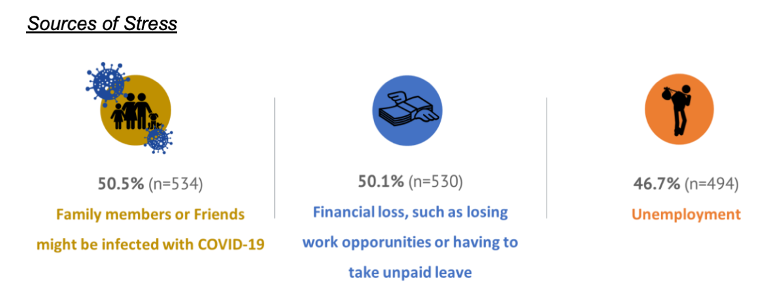
Fig. 1: Sources of Stress (Image extracted from Ministry of Health)

Fig. 2 (Image extracted from Science Direct)
Mood is an internal state of feeling at specific times and situation which is greatly correlated to the concepts of affect and emotion. Relatively, mood state has also been found to have an impact on people’s performance. For instance, low mood can lead to poorer cognition generally and can also affect how people approach stressful situations (Science Direct, 2022). Robots for entertainment (47 cases and 21 different robot models) and edutainment (8 cases and 4 different robot models) (Fig. 2) were deployed in schools, nursing homes, etc. as they present a strong social component with functions such as playing games, reading news, displaying photos and videos on screen among others (Aymerich-Franch, Laura, and Iliana Ferrer, 2022). Such deployment will improve the psychological and mental health as human-human interaction has been limited due to self-isolation.

Fig. 3 Division of the healthcare spectrum during COVID-19
Information Technology known as the study/use of systems were greatly explored amidst the sudden outbreak of COVID-19 which resulted in additional work of operations to the health sector given the wide care spectrum (Fig. 3) causing insufficient manpower. Researchers and innovators are providing new solutions for the rising challenges in the healthcare sector for instance – Artificial Intelligence (“AI”) helping the radiologist to analyse patterns of the image and assess the probability of infection (Tavakoli, Mahdi, Jay Carriere, and Ali Torabi, 2020).

Fig. 4 Total COVID-19 Cases in Singapore (as of 5 March 2020)
With cases rocketing in early months of 2020 (Fig. 4), Singapore has announced Circuit breaker (Fig. 5), mainly on the border controls (external) and measures (internal) that were implemented without much notice. Internal measures such as restricting one from leaving their homes except to buy food and daily essentials, or for urgent medical needs, food and beverages (“F&B”) are only allowed to sell takeaways and restrict dine-in (Government Agency Website, 2020). With such restrictions in place, business losses and unemployment were the causing emotional and financial stress to business owners and employees respectively. Referring back to Fig. 1, it shows that 50.5% of responses comes from a negative mental stressor – family members or friends infected with COVID-19, 50.1% comes from a negative financial stressor – financial loss, such as losing work opportunities or having to take unpaid leave and 46.7% of responses stressed over unemployment.

Fig. 5 Key Events/Measure in Singapore’s Response to the COVID-19 Pandemic (1 January to 6 April 2020)

Fig. 6 UVD Robots
Ultraviolet light disinfection (“UVD”) robots are being used to disinfect hospitals (Fig. 6). Denmark has shipped hundreds of its robots to China and Europe during the pandemic. At the end of 2019, UVD projected a 2020 growth rate of 400%, but the company has already hit 5x that. In February, the company sold more robots in a single day than it had during its first full year of commercial viability (Healthcare Purchasing News, 2020).

Fig. 7 Robot strategy for an aging world
As part of its robot strategy, the government began to provide robot subsidies to nursing homes in 2015. Already by 2016, about 15% of the country’s nursing homes had adopted robots. To examine nurse staffing and quality of care, the researchers will use both survey data and administrative data from the universe of nursing homes in Japan in the Japanese government dataset, Kaigokensaku, which provides basic data on the universe of care facilities (Freeman Spoqli Institute, 2021).
In conclusion, technology enhancement (artificial intelligence) and robots are gradually taking over repetitive tasks and tasks that can be carried out during a time of crisis and beyond (e.g. disinfecting of hospitals). During a pandemic, governments would implement suitable restrictions, limiting the transmission of any virus. By encouraging such enhancement, will benefit not only individuals but a country as a whole as they are less likely mentally / psychologically affected.
References
Aymerich-Franch, Laura, and Iliana Ferrer. “Liaison, Safeguard, and Well-Being: Analyzing the Role of Social Robots during the COVID-19 Pandemic.” Technology in Society 70 (August 2022): 101993. https://doi.org/10.1016/j.techsoc.2022.101993.
Chen, Jacinta I-Pei, Jason Chin-Huat Yap, Li Yang Hsu, and Yik Ying Teo. “Covid-19 and Singapore: From Early Response to Circuit Breaker.” Annals of the Academy of Medicine, Singapore 49, no. 8 (August 30, 2020): 561–72. https://doi.org/10.47102/annals-acadmedsg.2020239.
Freeman, Instituite Spoqli. “The Impact of Robots on Nursing Home Care in Japan.” FSI, June 2021. https://aparc.fsi.stanford.edu/research/impact-robots-nursing-home-care-japan.
Healthcare, News Purchasing. “China Buys Danish Robots to Fight Coronavirus,” February 24, 2020. https://www.hpnonline.com/infection-prevention/crisis-planning-outbreak-response/article/21126753/china-buys-danish-robots-to-fight-coronavirus.
Henkel, Alexander P., Martina Čaić, Marah Blaurock, and Mehmet Okan. “Robotic Transformative Service Research: Deploying Social Robots for Consumer Well-Being during COVID-19 and Beyond.” Journal of Service Management 31, no. 6 (2020): 1131–48. https://doi.org/10.1108/josm-05-2020-0145.
Rosenbaum, Mark S. “Transformative Service Research: FOCUS on Well-Being.” The Service Industries Journal 35, no. 7-8 (June 2015): 363–67. https://doi.org/10.1080/02642069.2015.1025061.
Science, Direct. “Mood State.” Mood State – an overview | ScienceDirect Topics. Accessed October 10, 2022. https://www.sciencedirect.com/topics/engineering/mood-state.
Tavakoli, Mahdi, Jay Carriere, and Ali Torabi. “Robotics, Smart Wearable Technologies, and Autonomous Intelligent Systems for Healthcare during the COVID‐19 Pandemic: An Analysis of the State of the Art and Future Vision.” Advanced Intelligent Systems 2, no. 7 (2020): 2000071. https://doi.org/10.1002/aisy.202000071.
Website, Government Agency. “Circuit Breaker Extension and Tighter Measures: What You Need to Know.” MCI - Gov.SG, April 21, 2020. https://www.gov.sg/article/circuit-breaker-extension-and-tighter-measures-what-you-need-to-know.
Comments